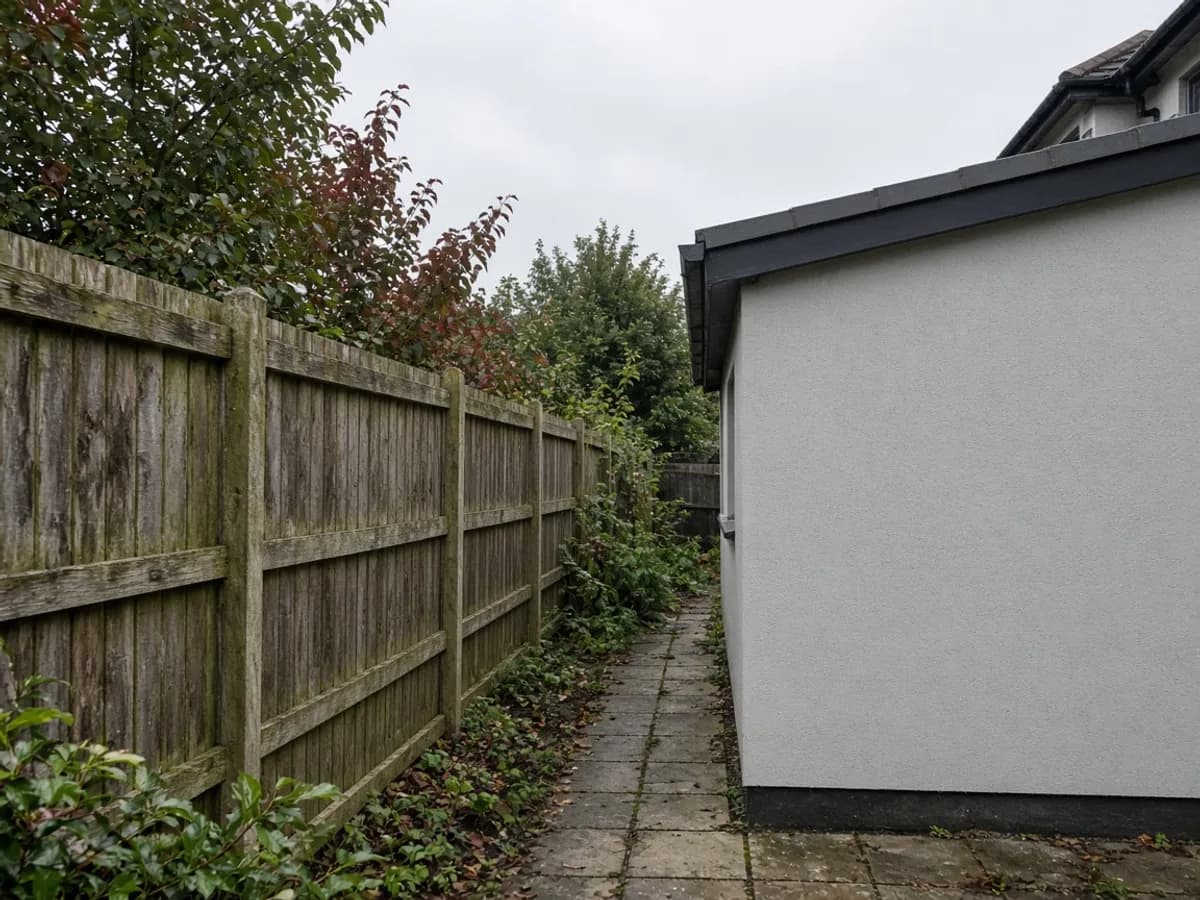
Most boundary arguments begin as a weekend with a tape measure and end as a folder of emails. A survey will not make you friends. It can stop the conversation being about whose memory is kinder.
Measure occupation while it still exists
The cheapest boundary survey is the one done before a fence is ripped out. Posts, old gravel boards, a change of brick — those are evidence. Once they are in a skip, you are left with title geometry and photographs that nobody dated. If you are early, take pictures now and then call for a measured plan.
We record what we can see from your land and from public highway. We do not climb the neighbour’s fence. If the feature is hidden in a hedge, the drawing will say so instead of inventing a confident line.
Title is a witness, not a judge
Overlay HM Land Registry geometry where the site is in England or Wales. Read the title-plan note first so you know what that overlay cannot do. In Glasgow we will not paste English habits onto a Scottish deed plan.
Solicitors, not survey websites, write the letter. We give them a plan, photographs keyed to it, and a short narrative of uncertainty. We will not declare a legal boundary on a web form. We will not pretend a determined-boundary application is a product we can add to a cart.
When the real need is design
If you only want to know whether an extension fits, you may need a topo with a boundary layer, not a forensic report. London side returns and Cardiff terraces are full of that brief. Add a building survey if the wall you are attaching to is the thing that will move the design.
Stay civil as long as you can. Once lawyers are the only people speaking, the survey is still useful — it is just more expensive than it needed to be in March.
Photographs that earn their place
Date them. Face them along the line and across it. Include something that will still be there in five years — a house corner, a manhole — not only a close-up of a post that will be in a skip. We key ours to the plan. Your weekend photographs can still help if they show a feature that later disappears.
Written notes help too: who built the fence, who paid, who has mowed which side. Those notes are not a survey. They are context a solicitor may want beside a survey. Do not ask us to turn them into a legal conclusion in a caption.
Mediation, letters and the drawing’s job
Some neighbours settle when they see the same dimension. Some do not. The drawing’s job is to be dull and true. If you want advocacy, that is a different professional. We will not write a thunderous covering letter on this brand, and we will not appear as an “expert” on a website form.
If the line is actually a design constraint, go back to a topo and stop paying for forensic tone. If it is already a pre-action letter, bring the solicitor into the briefing so the sheet is written for that file.
A last pass before you hit send
Measure while the fence still exists. Date your photographs. Say whether anyone has already written a letter. Do not ask a website to determine ownership. Do not ask us to climb. If the real need is an extension that fits, buy land levels and stop paying for forensic tone.
If you want the product rather than the essay, start at topographical surveys or the contact form. The phone and inbox on this site are temporary; the brief you type is the reliable object.